
Why is Reality Mathematical?
Order, Abstraction, and Existence

From Galileo’s time to the present day, scientists have marveled at the uncanny fit between mathematics and the physical world. As Galileo put it, “the universe is written in the language of mathematics, and its characters are triangles, circles, and other geometric figures”. This insight—that nature obeys mathematical laws—has only deepened. Nobel laureate Eugene Wigner famously called it “a wonderful gift which we neither understand nor deserve” that mathematics so accurately describes physics. Physicist Sir Roger Penrose echoed this sense of mystery: he noted that human thought often seems guided toward “some eternal external truth” with a reality of its own. Similarly, Max Tegmark argues that the simplest explanation of physics is that our universe is itself a mathematical structure. In short, we face a profound question: why should abstract mathematics so perfectly govern the cosmos?
Mathematics in Physics and Cosmology
The evidence is overwhelming that mathematics not only describes but also predicts physical phenomena. Powerful theories written as equations have led to discoveries before their observation. For example, Paul Dirac’s relativistic wave equation for the electron (1928) had two solutions; Dirac interpreted the second solution as a new particle, predicting the positron years before it was seen. As Freeman Dyson noted, Dirac’s theoretical insights “were like exquisitely carved statues falling out of the sky… He seemed to be able to conjure laws of nature from pure thought”. Likewise, James Clerk Maxwell’s equations unified electricity, magnetism and light, predicting the existence of radio waves long before Hertz detected them. Albert Einstein’s field equations predicted phenomena such as the bending of starlight around the Sun and, a century later, gravitational waves. When Arthur Eddington observed starlight deflection in 1919, confirming Einstein’s theory, Einstein quipped, “I would have to feel sorry for God, because the theory is correct”, underscoring his confidence that mathematical reasoning would prevail.
These examples are not flukes. Modern physics at all scales—from quantum mechanics to cosmology—runs on math. The Standard Model of particle physics is a set of abstract symmetry equations whose only free parameters are tuned to experimental values; it successfully predicted the existence of the Higgs boson and numerous other particles. Einstein’s General Relativity (a system of tensor equations) predicted black holes, the cosmic expansion and now accurately forecasts gravitational-wave signals from colliding stars. In cosmology, quantitative equations describe the Big Bang, cosmic microwave background, and galaxy formation. In every case, mathematics has shown prescience: it often leads or runs in lockstep with experiment.
These successes highlight two key features of reality: its abstract structure and its intelligibility. The universe obeys precise, universal regularities (laws of physics) that can be written in mathematical form. Moreover, the human mind—by its own evolution on Earth—can grasp those patterns. Why should distant galaxies or subatomic particles follow the same mathematical rules we derive in a study, or why should we even be able to understand them? Cosmologist Paul Davies put it well: “Mathematics is universal. It’s discovered by human beings, but the rules of mathematics are the same throughout the universe and the laws of the universe.” (That humans can discover the same mathematics at different times and places is a fact we must explain.) This “unreasonable effectiveness” of math suggests something profound: our universe has a deep rational order awaiting discovery.
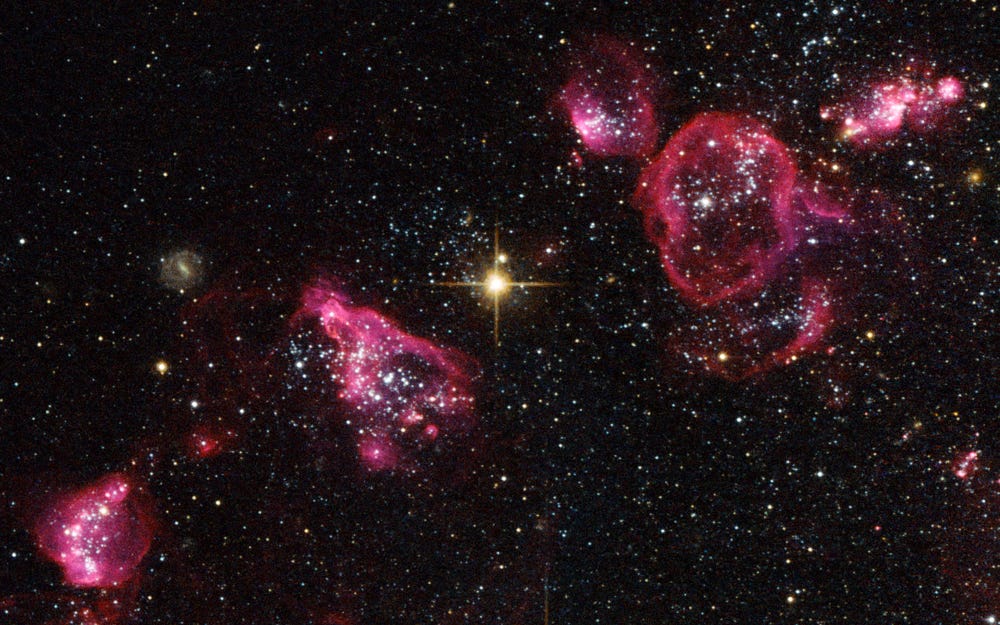
Today we also probe the cosmos with mathematics. Hubble Space Telescope images (such as nearby star-forming regions in a dwarf galaxy) are interpreted through general relativistic and quantum-mechanical models. Astronomers use spherical harmonics and tensor calculus to analyze gravitational waves and cosmic background radiation. All this relies on the power of mathematical structures—Hilbert spaces, Lie groups, differential geometry—to capture reality. The match is so precise that physicists routinely employ “beautiful” or symmetric equations (like the Dirac equation or Einstein’s field equations) as reliable guides. Indeed, mathematics not only summarizes what we see but actively governs and predicts new phenomena. It is not an empirical add-on but the very language in which the universe is written.
Philosophical Perspectives: Platonism, Conceptualism, and Naturalism
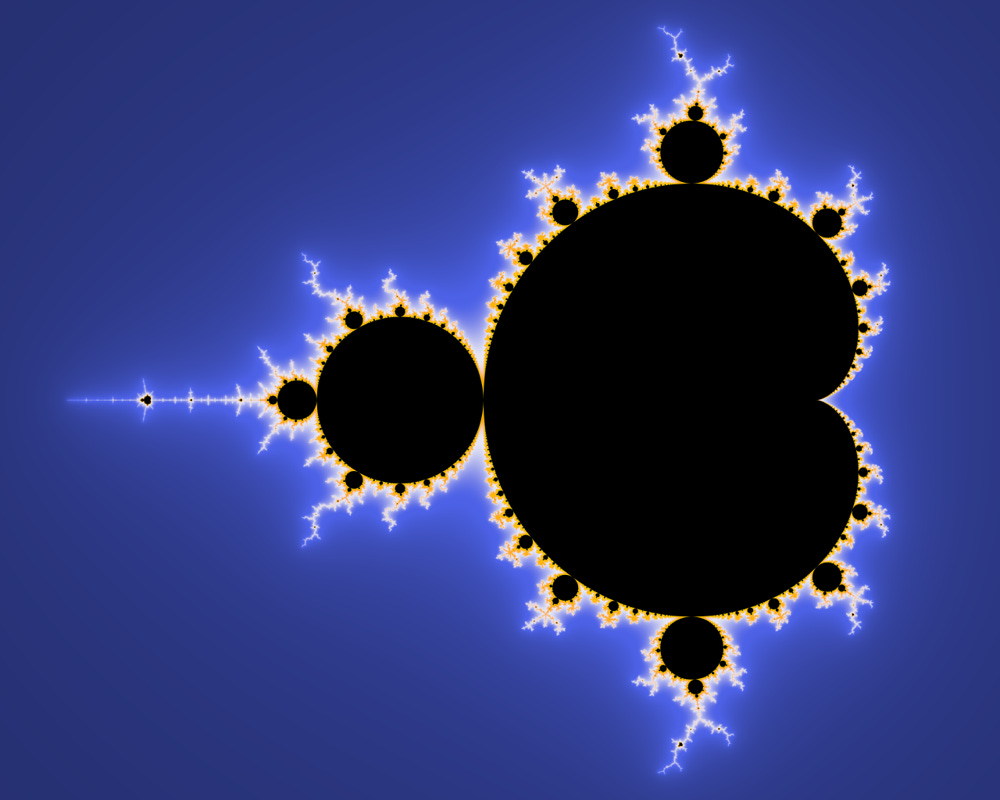
How should we interpret mathematics’ existence? One classical view is Mathematical Platonism: numbers, sets and other mathematical objects exist in an abstract realm independently of minds or physical reality. As the Stanford Encyclopedia explains, Platonism holds that “there are abstract mathematical objects… independent of us and our language, thought, and practices. Just as electrons and planets exist independently of us, so do numbers and sets.” In this view, mathematical truths are discovered, not invented. (Humans merely tap into an existing Platonic world.) Penrose is a modern Platonist: he argues that complex numbers, the Mandelbrot set, and other structures have a “reality of their own” beyond any particular human mind.
A contrasting approach is Theistic Conceptualism. Prominent in Christian philosophy, it holds that mathematical entities exist as concepts in the divine mind. In this view, God’s intellect contains all abstractions (numbers, laws, geometries) that then structure His creation. As one recent analysis puts it, “theistic conceptualism takes the referents of mathematical terms… to be concepts in the divine intellect”. Thus God knows all math, and the physical world reflects that knowledge. This view preserves the objectivity of mathematics (they truly “exist” as divine ideas) while rooting them in God rather than a mysterious Platonic realm. The “plan” or structure of the universe is the unfolding of God’s conceptual blueprint for reality.
Naturalist accounts (denying anything beyond the physical) face a steep challenge. Formalism or conventionalism treats math as symbolic games or human conventions, but that struggles to explain why such games consistently model nature. Intuitionism and constructivism tie math to the human mind, but then one must ask why evolved apes could invent an abstract theory of everything. Some try Nominalism, claiming mathematics is simply shorthand about physical objects. Yet then the “objects” (e.g. the set of all primes) have no physical embodiment, so this still fails to explain why statements about them have content. Overall, naturalistic philosophies tend to reduce math to contingency or utility—but they cannot easily explain its universality, abstractness, and the way it fits reality. The philosopher Reuben Hersh remarked that naturalism must somehow account for our “miracle of the appropriateness” without appealing to anything non-material. So far, no strictly physical account has rendered this intelligible: why should mindless matter “know” mathematics?
Naturalism’s Limits and the Benacerraf Problem
Two classic puzzles illustrate the difficulty for naturalism. Benacerraf’s dilemma points out that if numbers are non-physical objects, it’s mysterious how any physical brain could ever access them. Yet mathematicians do grasp objective mathematical truths with confidence. Second, the Quine-Putnam indispensability argument shows that science indispensably uses mathematics; Quine argued that we are therefore committed to the reality of mathematical entities. But even if we grant their reality to save science, we still need to explain why the universe is governed by these entities. Why the correspondence between a mind-independent reality and these abstractions?
Physicalism lacks resources here. Evolution can select for brains that model physical patterns, but it has no obvious way to explain, for example, the truths of transfinite set theory or the intricate structure of prime numbers—truths that seem uncannily mirrored in physics. Nor can mere quantum chance account for such precise regularities across scales and contexts. Mathematician Alexander Pruss summarizes the quandary: science has shown us astonishing new possibilities, but it has also revealed limits. A purely naturalistic worldview makes the deep success of mathematics seem like an accident, an “unreasonable effectiveness” with no explanation.
The Theistic Explanation
In contrast, theism offers a unified explanation for mathematics and the mind. If God is a perfectly rational and mathematical being, then it is no surprise that creation reflects mathematical order. God’s mind contains the abstract structures (numbers, symmetries, laws) that He then implements in nature. The human mind, made in God’s image, is capable of understanding those structures. In other words, God is the ultimate Mathematician. From this vantage point, facts like Galileo’s insight (that nature is written in math) and Wigner’s marvel become expected: a rational God would “write” the universe in a rational language.
This theistic picture neatly solves the puzzles. Abstract objects exist as divine ideas, so humans (as creators of language and reason by God’s design) can discover them. The correspondence between math and physics is explained because both stem from the same divine source. The mind’s ability to do math is explained by its origin in a mind-like God. No surprise then, for example, that physicists find the world “shot through with signs of mind” when they study its laws. Classical theists like Newton and Leibniz assumed a rational creator undergirded cosmic order; today this view is echoed in science. The author of Genesis called God the Word (Logos), and later theologians saw this as implying that creation is intelligibly ordered.
Conclusion: A Rational Worldpoints to a Rational Cause
In sum, the mathematical nature of reality remains one of science’s deepest mysteries. We have seen that physics and cosmology reveal a universe whose behavior is governed by precise equations and symmetries, often anticipating empirical discoveries. Philosophers and scientists from Plato to Penrose to Tegmark have emphasized that mathematics seems to exist independently and has uncanny access to the physical world. Naturalistic accounts struggle to explain why a material world gives rise to abstract, universal truths and rational minds. By contrast, theism provides a simple and powerful explanation: the universe is intelligible because it is the product of a rational Creator. God’s eternal, mathematical mind shapes the cosmos, and our own minds—created by God—can read that “book” of nature.
The evidence, in our view, thus points beyond mere chance. The “miracle” of mathematics in science and the mind’s surprising insight into it suggest that reality’s mathematical character is no accident, but a clue to its divine origin. In this sense, the unreasonable effectiveness of mathematics becomes a window into the reasonable—indeed necessary—explanation of a Creator who endowed the universe with order and gave us the minds to understand it.
Omg. I can definitely see a novel like this. A christian scientist that wins a nobel prize. The whole book is him accepting Christianity as an already renowned scientists, and as his relationship with God improves, you can see him literally having conversations with Him that lead to discoveries
God would just randomly say
"Yeah. I put that there in 200BC" 😂
This just makes science more interesting to me.
Instead of grasping at straws, its a treasure hunt to find what already exists. What God has "hidden". Just waiting for his adorable creatures to figure out.