
Information Is Not Physical
The Case for Mind Before Matter

Information is fundamentally different from matter and energy. At first glance, we often conflate the two: we see DNA as a physical molecule, ink on a page, or vibrations in the air, and we assume the “information” in them is just another form of physical substance. However, modern science makes a clear distinction. Information – by its very nature – is abstract. It is about patterns, relationships and meaning that transcend any particular physical medium. As Norbert Wiener, the founder of cybernetics, put it, “information is information, not matter or energy”. In other words, the meaning contained in a pattern of 0s and 1s, or nucleotides, or letters on a page is not itself a physical object with mass or energy. It is an abstract concept that can only be instantiated or carried by a physical substrate.
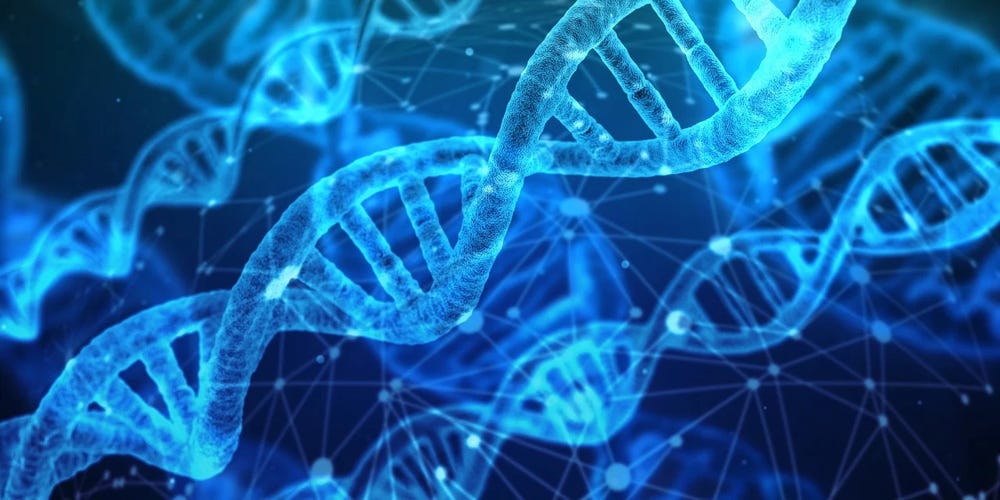
This abstractness is evident in everyday examples. A strand of DNA (a long molecule of deoxyribonucleic acid) has a definite physical shape and mass, but the genetic instructions it carries – the information that tells a cell how to build proteins – is not a property of its atoms in isolation, but of the sequence of its parts. Similarly, ink on paper is material, yet the message of a book (the meaning of the words) is not in the ink itself but in how the reader interprets the sequence of letters. Sound waves are a physical vibration in the air, but the meaning of speech is only there because a mind (listener) interprets those vibrations as words. Thus the same physical medium can carry different information depending on how it is arranged or read. Physicist Melike Lakadamyali and colleagues note that Watson and Crick’s discovery of DNA’s structure in 1953 “provided the fundamental understanding of how DNA encodes genetic information and how it is replicated”. The molecule is the storage medium, but the code is an abstract set of instructions. In every case, we see that information is not reducible to physical stuff – it is a separate layer of meaning that rides on top of matter.
Likewise, when we see text on a page, ink is the physical medium, but the message is abstract. A book’s letters and punctuation are real ink marks, yet the story they convey only exists in the interplay between those marks and the reader’s understanding. A good analogy is this: imagine you have a deck of cards painted with different symbols, and you arrange them to spell words or recipes. The cards and paint are physical; the words and instructions are meaning, not physical. This crucial distinction – that information content (semantics) is not the same as the physical medium – was formalized in Shannon’s information theory. Shannon demonstrated that any communication system can be described abstractly in terms of bits of information, independent of the physical form of the signal. We will explore below how Shannon’s framework makes clear that meaning is deliberately left out of the equation, highlighting that information is non-physical.
Shannon’s Communication Model: Separating Signal from Meaning
Claude E. Shannon’s 1948 landmark paper A Mathematical Theory of Communication laid the foundations of information theory. Shannon was an electrical engineer interested in how to send messages reliably over noisy channels. Crucially, Shannon showed that information can be quantified without regard to what the messages mean. He modeled a communication system in purely mathematical terms:
Information Source: produces the message (a sequence of symbols).
Transmitter: encodes the message into a signal.
Channel: the physical medium carrying the signal (wire, radio waves, etc.).
Receiver: reconstructs a message from the received signal.
Destination: the person or device for whom the message is intended.
In Shannon’s view, the job of communication theory is to reliably transmit any possible message from the source to the destination, even if we do not know in advance what the message will be. As he famously stated: “Frequently the messages have meaning; that is they refer to … certain physical or conceptual entities. These semantic aspects of communication are irrelevant to the engineering problem”. In plain terms, Shannon says: Engineers can figure out how to send messages without worrying about what those messages mean. Whether a message is meaningful or a random string of characters, it still has “information” in Shannon’s sense if it reduces uncertainty.
For example, whether a bit pattern represents the sentence “HELLO WORLD” or a scrambled code, Shannon’s formulas (like entropy) quantify how many bits are needed to encode the data for transmission, but not what the bits say. Shannon’s bit is purely an abstract unit of information. He defined a bit as the log of the number of possible messages (so with base 2, one bit distinguishes two equally likely messages). The point is that the content of the message (its semantics) does not enter into that calculation. Engineers only care that the channel can handle any message drawn from the set of possibilities. As one interpretation puts it: “At its core, communication is like a game of telephone… messages often mean something — but for the engineers building communication systems, the meaning doesn’t matter. What’s important is that the system can handle any message you throw at it, because we don’t know in advance what message we’ll need to send.”
Shannon’s model makes clear that meaning requires both a sender and a receiver with shared context. The same string of symbols can mean entirely different things depending on the codebook or language used. For instance, the bit sequence 01100001 might mean “a” in ASCII, but if interpreted as a picture file it could render a completely different pattern. Likewise, the DNA codon sequence “AUG” in biology codes for the amino acid methionine (and the start of a protein), but if read by a chemist as molecules, one might think of its chemical name instead. Without the appropriate cellular “receiver” and genetic code “dictionary,” the raw DNA molecule carries no meaning. Shannon’s communication diagram illustrates this: the destination is the ultimate decider of meaning. If there is no destination that understands the encoding, the “information” is just random signals.
In summary, Shannon formalized the abstraction of information: it is a count of possibilities, not tied to any particular physical form or interpretation. This abstraction is why we can talk about information flows in computer networks, the brain, and DNA all with the same theory, even though the actual signals differ wildly.
DNA and Biology: Physical Molecule, Abstract Code
Biology gives a vivid example of information vs. matter. DNA is a physical double-helix polymer made of four types of nucleotide bases (A, C, G, T). But its power lies in the sequence of those letters. This sequence constitutes the genetic code that tells cells how to build proteins and regulate functions. Importantly, the meaning of a DNA sequence comes from how cellular machinery (ribosomes, polymerases, etc.) reads it, not from the chemistry of the DNA molecule alone.
Studies on genome organization highlight that DNA’s structure enables it to encode genetic information. As one review notes, Watson and Crick’s discovery “provided the fundamental understanding of how DNA encodes genetic information and how it is replicated”. The nucleotide sequence itself is the information content; the backbone and molecular bonds are merely its carrier. In other words, DNA is like a hard drive: the disk is physical, but the files on it are data.
Crucially, changing the sequence changes the information even though the chemistry is almost identical. Consider a segment of DNA made of bases G-C-T-A. If you swap one letter (say change GCTA to GCAT), the resulting information content (the “message” to the cell) changes. The physical molecule has the same atoms (only one base changed), but the code it encodes is different. This parallels how swapping letters in a word changes meaning: “cat” vs. “act” use the same ink, but one means a pet and the other means a deed. No law of chemistry forces DNA to have any particular sequence; sequence patterns (information) arise from biological replication and mutation, not from the underlying physics of atoms.
Even beyond individual sequences, biology is full of algorithmic control systems and symbolic codes. For example, a sequence of DNA instructions is transcribed into RNA and translated via the genetic code to make proteins — a multi-step symbolic process. Each step interprets the sequence according to “codebooks” built into the cell. There is nothing in physics like a “translation rule” built into bare matter. In fact, physicists and philosophers observe that “all quantities appearing in the laws of physics are physical, observable and measurable, and the meaning, however, is abstract, unobservable and unmeasurable”. In biology, the information is specified by arbitrary conventions (like which codon means which amino acid) that have to be imposed by a system, not derived from physics.
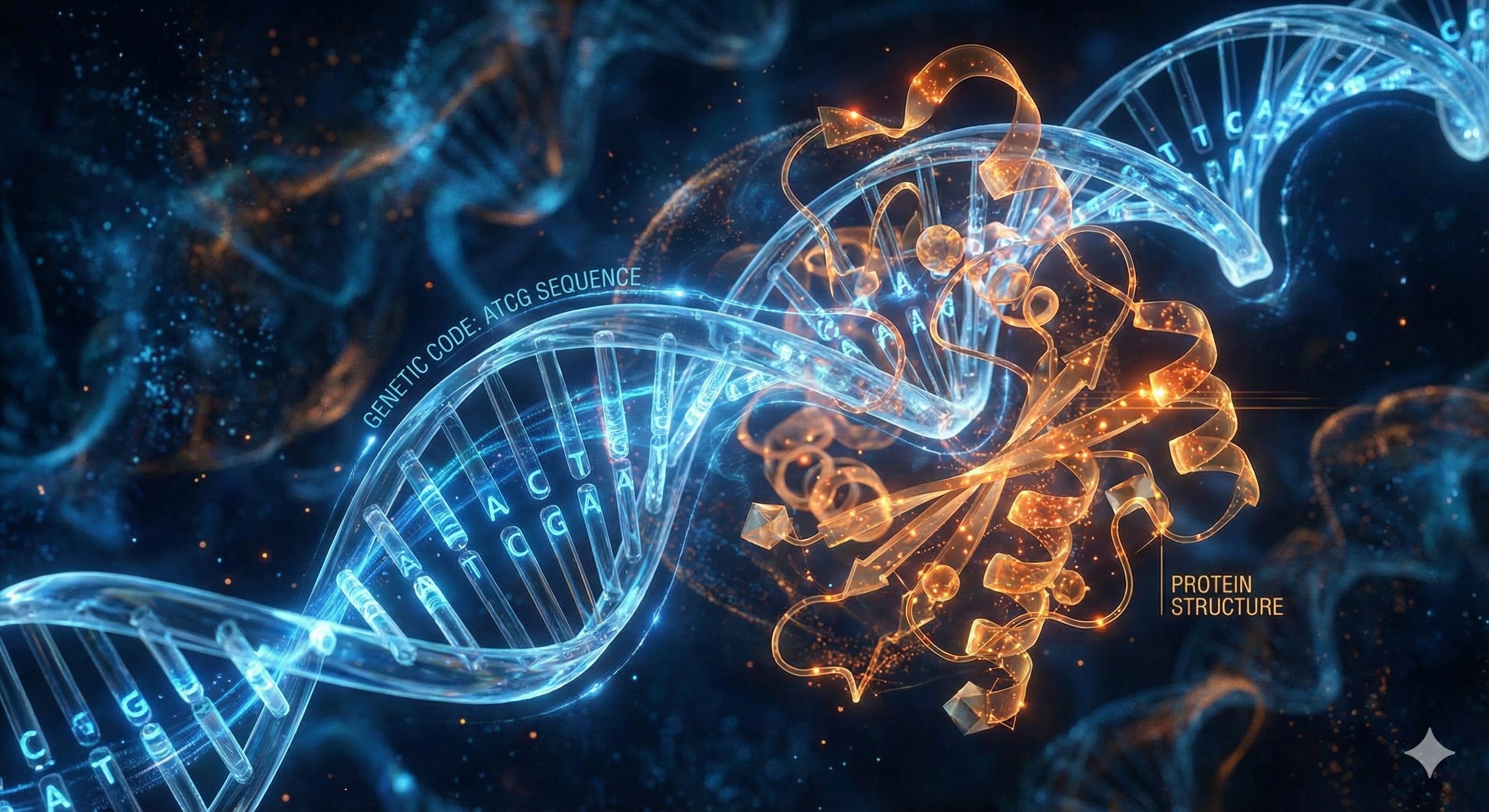
This contrast can be seen in the famous example of codons (three-base “words” in DNA) versus English words. The genetic codon “UUU” stands for the amino acid phenylalanine; “CGA” stands for arginine. These codons have meanings only because of the cell’s translation machinery. Likewise, the English letters “CAT” have meaning (a furry animal) only to readers of English. If we wrote “CAT” in a textbook, the paper has ink (physical) but the word is an arbitrary symbol that any English speaker can interpret as a cat. The analogy is clear: DNA’s raw sequence is like ink on paper, and the genetic code is the language grammar. As one authority explains, DNA “simply provides a ‘library’ of information and the use of that information is controlled not by the genes themselves but by the cell”. The control and meaning come from the cellular context (the “reader” and “interpreter”), not from the DNA molecule per se.
Books and Speech: Medium vs Meaning
The same principle holds for written and spoken communication. Take a printed book: the paper and ink are physical, but the story and ideas are abstract. The letters on these pages have value only when a mind interprets them. For instance, the English word “bat” consists of black ink shapes on white paper, but the meaning (a flying mammal or a baseball bat) depends on the reader’s knowledge. Change the ink and paper to Arabic script, and the same concept can still be conveyed, even though the medium is completely different. This shows that information transcends its medium.

Likewise, a spoken word is a pressure wave in air, yet the semantic message is in the auditory pattern as recognized by a listener. Two people can say the same wave pattern (sound) but mean totally different things if spoken in different languages or with different intonations. The physical vibrations carry potential meaning, but that meaning is unlocked only in the presence of a listener who knows the language.
Consider the relationship between sound waves and words: one person might say “hola” (a sound wave pattern) in Spanish meaning “hello”, while a person hearing it in English might only catch the sound without meaning. The same sound can have no meaning, a positive meaning, or even a negative meaning, depending on the listener’s understanding. In Shannon’s terms, the channel can be anything (air, radio waves, etc.), but the source and destination share the codebook (language) that gives the information content.
These examples underscore that information has multiple dimensions beyond the purely physical. Information scientists sometimes speak of syntax, semantics, pragmatics, etc. For example, William Dembski’s “complex specified information” adds meaning to Shannon’s concept by demanding an independently recognizable pattern. Werner Gitt’s theory of information even lists five dimensions (statistical, syntactic, semantic, pragmatic, and apobetic). What is important here is that physics as conventionally formulated does not account for these higher layers. The ink on the page or the sound wave can be described by optics and acoustics, but those laws have no built‑in notion of the words “bat” or “hola”. As Richard Wang summarizes: the rules that map symbol patterns to meanings “cannot be the laws of physics” because they deal with abstract, unmeasurable meanings. In short, meanings live in minds, not in molecules or waves.
Shannon’s Insights Applied: Information ≠ Medium
Claude Shannon’s formalism highlights that any medium – DNA, ink, radio waves, electrical pulses – is just a vehicle. One could rewrite the Bible in DNA by encoding letters as nucleotides, or send the genetic code through a telegraph, and the text’s meaning would survive, albeit in a strange form. The physical substrate changes, but the information remains the pattern. This is why Shannon and others emphasize that information is abstract and implementation‑independent.
Landauer and colleagues made a famous phrase out of this connection: “Information is physical”. That statement was meant to highlight that information, to exist in the world, must be instantiated physically (bits must reside on a hard drive or in some medium). It emphasizes that you can’t have disembodied data – every signal has a medium. But as Scott Aaronson points out, this slogan is easily misunderstood. It does not mean that information is matter or energy. In fact, one can agree with Landauer that information has to be embodied to be used (you need a physical bit), while still holding that the essence of information (its content and meaning) is not itself a substance.
Indeed, recent research has shown that even Landauer’s idea about the physical cost of information processing is subtle. An experiment in 2016 demonstrated that one could operate a logic gate (an “OR” gate) with arbitrarily little energy, contradicting the notion that erasing a bit must dissipate a minimum kTln2 of heat. As a Phys.org summary concluded: “Though Landauer famously said ‘information is physical,’ it turns out that information is not so physical after all.”. This reinforces the point: the information (the abstract change in logical state) is decoupled from the energy consumed by the physical device. While physics dictates how bits move and change energy states, it does not dictate what bits mean or how they get interpreted.
The Gap in Physics: No Mechanism for Semantic Information
Biology and technology alike are packed with “semantic information” (meaningful messages), “instructional code” (like software or DNA instructions), and “algorithmic control systems” (like metabolic networks following coded instructions). Yet no known physical law produces semantics or purpose on its own. The fundamental laws of physics describe forces, particles, and energy exchanges – they do not contain any variables for meaning, purpose, or truth. For instance, the equation E=mc² tells us how mass relates to energy, but it says nothing about what that mass means or any semantic content it might carry.
To see this gap, imagine a random sequence of DNA emerging by chance chemistry. It would not automatically produce meaningful proteins or organisms. Natural laws might increase entropy or move atoms, but they have no mechanism for assembling a functional gene that spells out a protein structure. In algorithmic terms, there is no built-in “grammar” in physics that says certain arrangements of particles signify specific instructions. Richard Wang emphasizes that the rules tying symbols to meanings do not obey physical laws. In human language, syntax and grammar come from linguistic conventions, not from electromagnetism. Similarly, the genetic code (which codon -> which amino acid) is a biochemical convention (likely historically fixed by evolution) but not derivable from physics equations.
Philosophers have long noted that meaningful information – like the content of a message or the instructions in a computer program – requires a context of interpretation. Without a mind or an interpreter, sequences of bits or bases have no significance. In practice, we observe that all known sources of nontrivial information involve intelligent agents. Every time we see a sequence that carries specified meaning (from a text message to a genome), we find a conscious mind or natural selection (which itself encodes information over generations) behind it. Physicist Paul Davies notes that there is no known physical principle that creates information from nothing without some kind of intentionality or history. (Indeed, one commentary on the origin of life quotes Davies: “There is no known law of physics able to create information from nothing”.)
This empirical fact is sometimes called the “law of information” in informal terms: information (especially specified, functional information) always has a source. When we turn on a computer game or listen to a speech, we know humans created the code or words. When we see DNA instructions that build a cell, we know they emerged through biological evolution or design. In no case does a pure physics experiment magically yield a meaningful message (e.g. Maxwell’s demon aside, meaning is conspicuously absent from thermodynamics).
The flip side is that life – from cells to humans – is saturated with information: genetic programs, neural codes, languages, and cultures. It is astounding that the universe’s most complex systems teem with meaning and purpose, yet these aspects find no explanation in fundamental physics. Physics can tell us how particles scatter, but not how genes instruct development or how thoughts form. This contrast between the profound abstract order in biology and the semantic blindness of physics sets the stage for a deeper perspective.
Mind Before Matter: A Theistic Perspective
When we recognize that semantic information, codes, and algorithms are not products of blind physics, a profound implication emerges: information seems to point back to Mind. In the natural world and in technology, every instance of meaningful information traces to an intelligent source. This suggests that mind or consciousness may be more fundamental than mere particles. In fact, famous scientists have noted something similar. Max Planck, one of the founders of quantum theory, observed that “all matter originates and exists only by virtue of a force… We must assume behind this force the existence of a conscious and intelligent mind”. He saw that the ordered universe hints at Mind at its core.
Viewed this way, the nature of life and information aligns with the idea that mind precedes matter. If every bit of true information comes from an intellect, then the immense informational content in the genome and in consciousness itself points to an intelligent source beyond mere material processes. This echoes the opening of the Gospel of John in the Bible: “In the beginning was the Logos (the Word), and the Word was with God, and the Word was God.” Here the Logos (a Greek term meaning “Word” or “Reason”) is a divine Mind or intelligence that undergirds reality. Scientifically, one could paraphrase: “In the beginning was the information, and that information was personal.”
Putting it another way: if information is the currency of life, and information comes from mind, then it suggests that consciousness (or a Mind) is foundational. The material world—including you and me—could be seen as a complex information-processing system arising out of that Mind. Importantly, this does not contradict science; it simply notes that science cannot account for meaning on its own. Just as observing a coded message implies a sender, observing life’s informational complexity implies an intentional intelligence.
We should stress that these conclusions are drawn by following the science of information to its logical end, not by dismissing science. Information theory tells us what physics and chemistry can and cannot do with information. It tells us that while physical laws govern the behavior of energy and matter, they are silent on questions of meaning and purpose. In contrast, theology (or philosophy) picks up where science leaves off, offering that behind the physical laws there is a Mind that embeds meaning into the universe. This view is harmonious with the central idea of theistic religions: that Mind (God, the Logos, the Word) is the ultimate source of reality and order.
In summary, information theory shows us that information is not physical. It is an abstract realm requiring a conscious interpreter. DNA and books, computers and songs, all illustrate that the medium (matter and energy) is secondary to the message (meaning). Shannon’s theory mathematically formalized this separation, and modern research confirms it. When we trace the arrow of explanation from chemistry to biology to intellect, we find that meaning and instruction always trace back to mind. For the scientist who is also a person of faith, this leads to a beautiful resonance: the Creator, or God, who is Mind, is “in the beginning” – the source of the Word, the source of all information. Thus, in the language of science and theology together, mind precedes matter, as the Logos preludes creation.
Key Takeaways:
Information ≠ Medium: Information is an abstract, meaningful pattern (like code or text) that rides on a physical substrate (like DNA or ink). The same physical thing can carry different information if interpreted differently.
Shannon’s Model: Claude Shannon showed that communication can be analyzed without meaning. A channel and bits can reliably transmit any message, but the theory deliberately ignores semantics. Meaning only exists with a sender, codebook, and receiver.
Semantic Gap: No law of physics by itself produces meaningful information or purpose. Physical laws deal with energies and forces, not with syntax or semantics.
Life and Information: Living systems use complex informational codes (genetic, neural, etc.) that require interpretation. This suggests an intelligence behind the information. As Norbert Wiener noted, “information is information, not matter or energy”.
Theistic Insight: If information (the Word/Logos) is fundamental and always comes from mind, then Mind (God) precedes and sustains the physical universe. This aligns with “In the beginning was the Word,” connecting modern science with ancient wisdom.